
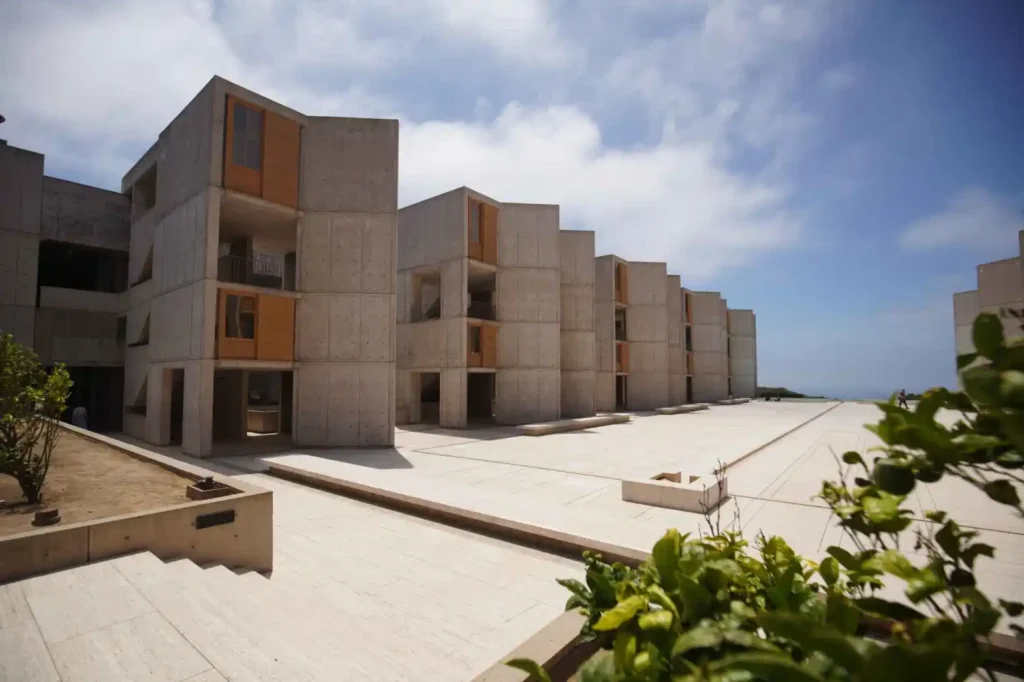
The Salk Institute in La Jolla is among the local medical research centers that would be eligible for billions in funding under Proposition 38. This photo is from August 2025. (Michael Ho / The San Diego Union-Tribune)
In 2017, I was diagnosed with amyotrophic lateral sclerosis (ALS), also known as Lou Gehrig’s disease.
Before the diagnosis, I spent four years in the United States Air Force and 32 years working in information technology. I had a career, raised a family and made plans for retirement. None of those plans included living with a disease that can take away a person’s ability to walk, talk, eat, use their hands and eventually breathe.
As long as I can still communicate, I will keep fighting for more research funding to find a cure. That’s why I’m voting yes on Proposition 38, the California Immunology Medical Research and Cures Initiative.
Proposition 38 provides $8.4 billion in vital funding to accelerate life-saving immunology research at California’s nonprofit universities and research institutions. Immunology is the science of using the body’s own immune system to find and stop diseases.
Most importantly, immunotherapies are already saving and extending patients’ lives. Research supported by Proposition 38 could prevent, treat and cure a whole range of diseases, including ALS, Alzheimer’s, Parkinson’s, diabetes, muscular dystrophy, rheumatoid arthritis, lupus and multiple sclerosis.
This kind of research is especially important to members who’ve served, as U.S. veterans are 1.5 times more likely to get ALS than people who never served. Veterans Affairs recognizes ALS as a presumptive service-connected condition for anyone who served at least 90 days of continuous active duty, and we need to invest in more research to understand the underlying causes of ALS and how to better treat and prevent it.
For patients like me, medical research is not an abstract policy debate. ALS changes the way you think about time. You stop assuming you have years and start measuring life in milestones. One of mine is seeing my son graduate from college.
Nearly a decade after my diagnosis, I know how fortunate I am to still be here, which isn’t always the case with an ALS diagnosis. I’m still making plans and I have hope that treatments or even a cure isn’t a generation from now but in a few years.
Because let’s be clear: ALS is not incurable; it’s underfunded.
We need more sustained resources and cutting-edge research devoted to understanding diseases and developing better treatments. Stable, sustained medical research means another treatment to try. Another clinical breakthrough. Another birthday. Another family dinner. Another graduation.
Federal funding cuts are slowing and shutting down research at California’s universities and nonprofit institutions. Patients and families don’t have years to wait for Washington to sort itself out. Beyond national leadership, Proposition 38 gives California a stable, in-state source of funding so the work keeps moving at a pace our lives literally depend on.
Proposition 38 is also designed to pay for itself: 10% of licensing proceeds from successful immunotherapies return to the state to pay off the bonds, the interest and continue to reinvest in the research. The measure also caps state administrative costs at 2%, so the vast majority of every dollar goes directly to research rather than overhead. Independent financial audits, conflict-of-interest safeguards and public disclosure of spending are all built in.
And any treatment that comes out of this work will be made available to Californians at a 20% discount below the national average. Proposition 38 creates two distinct funding streams. Half of the $8.4 billion would go to a single nonprofit immunology research institute affiliated with a University of California campus and selected by the California Department of Public Health based on the measure’s criteria. The other $4.2 billion would be awarded through competitive research grants to eligible California public and nonprofit universities and research institutions, never to for-profit companies. That includes local institutions right here in San Diego, like UC San Diego, La Jolla Institute for Immunology, Scripps Research Institute, Sanford Burnham Prebys Medical Discovery Institute and Salk Institute for Biological Studies, places already doing the work this measure is meant to accelerate.
Life-saving breakthroughs will come. For patients like me, the question is whether they will come soon enough.
I’ve spent years since my ALS diagnosis fighting for funding, meeting with congressional representatives and testifying to prioritize life-saving research. I’d do anything that helps give today’s patients a healthier future, and Proposition 38 is how California keeps that fight going.
Please vote yes on Proposition 38. It could save your life or the life of someone you love. And it may just help me see my son graduate from college.
Ybarra is an ALS survivor, advocate and ALS Association trustee member who lives in La Mesa.